How are you feeling today?
Pick what’s closest. This only suggests a place to explore — it isn’t an assessment, and nothing is saved or sent anywhere.
Explore at your own pace
All eight areas are open now — and nothing here will ever need an account or a subscription.
Frequency Studio
A real tone generator — 432 Hz, 528 Hz, the full Solfeggio set, and true binaural beats, with volume and a session timer.
Start listening →Body & Wellness Map
Tap a region of the body to learn what it does, a gentle wellness practice, and its traditional chakra association.
Open the map →Chakra Library
All seven main chakras — traditional meanings, colors, everyday practices, and a “play its tone” button for each one.
Browse the library →Research & Evidence
How we label every claim on this site: what science supports, what’s still being studied, and what comes from spiritual tradition.
See how we label →Earth Frequencies
The Schumann resonance — Earth’s own electromagnetic background hum near 7.83 Hz — with the live spectrogram from Tomsk State University, drawn fresh every few minutes.
See the live chart →Astrology
Western and Vedic natal charts, calculated in your browser from your birth moment: a chart wheel, Placidus houses and aspects on one side; nakshatras and the Vimshottari dasha timeline on the other.
Build my charts →Human Design BodyGraph
Your full chart, calculated in your browser from your birth moment: Type, Strategy, Authority, Profile, centers, channels, and all 26 activations. Birth details never leave your device.
Build my chart →Feedback
Spot something that isn’t correct, something broken, or have an idea? Send a note straight to my inbox — corrections are welcome here.
Send feedback →Frequency Studio
These tones are generated live in your browser at exactly the frequency shown — no recordings, no streaming. A frequency being measurable in Hz is science; what a tradition says it means is labeled as tradition, here and everywhere on this site.
🎧 Tone Generator
Start at a low volume. If a tone ever feels uncomfortable, lower it or stop — listening should always feel gentle. The player starts conservatively, fades in and out smoothly, and never stacks tones on top of each other. Read Sound Safety & Responsible Use →
Pairings between a Solfeggio tone and a body part, theme, or chakra are modern spiritual associations — meaningful in contemporary practice, not scientifically established treatments and not presented here as universally ancient teachings.
Starts at a conservative 20% with a gentle fade-in. This percentage is not a guaranteed safe level — your device and headphones decide the real loudness, so always start low and adjust to comfort.
If the audio engine shows suspended after you switch apps or lock the screen, that is your browser or phone pausing web audio in the background — the session itself has not been cancelled. The session timer keeps counting down in real time while suspended, and the tone still ends at its scheduled time. Some browsers show interrupted when a phone call or a Bluetooth change takes over the audio. When you return to this page, the engine normally returns to running on its own. Watching this readout while you test is the easiest way to tell a browser restriction apart from a problem in the player itself.
What’s actually happening
Your browser’s audio engine creates a pure wave oscillating at the exact rate shown — 528 times per second for 528 Hz. That part is plain physics, and you can verify it with any free frequency-analyzer app held near your speaker.
Supported Sound and music can help many people relax, and music-based therapies have research support for stress and some symptoms.
What tradition says
Solfeggio frequencies come from a tradition linking specific tones to healing themes — 528 Hz with transformation, 396 Hz with releasing fear, and so on. Those meanings are meaningful to many people, and you’re welcome to explore them here.
Tradition Still being studied Clinical evidence that one specific audible Hz heals a specific organ is limited — we won’t claim otherwise.
Sound Safety & Responsible Use
Listening should feel gentle and be easy to stop. This section explains how to listen safely, what this site can and cannot do, and how we keep science and tradition honestly labeled.
🦻 Hearing protection
- Always begin at a low volume and increase slowly only if it stays comfortable.
- Avoid prolonged listening at high volume, and take regular breaks.
- Stop listening and rest your ears if you notice discomfort, pain, ringing (tinnitus), muffled hearing, dizziness, or headache.
- If ringing or hearing changes persist, seek advice from a qualified hearing professional.
🔉 A safe starting volume
The generator now starts at a conservative 20%, with a smooth fade-in when you press Play and a smooth fade-out when you press Stop or the timer ends, to reduce sudden sounds and clicks.
No slider percentage guarantees a safe listening level. The same 20% can be quiet on one phone and loud through amplified headphones on another. Your device volume, headphone type, and surroundings all matter — when in doubt, turn it down.
🎧 Headphones & binaural beats
Traditional binaural-beat playback requires stereo headphones or earbuds. It works by sending a slightly different frequency to the left ear and the right ear; your brain perceives the difference as a beat.
On speakers, the two tones mix in the air before reaching your ears, so you hear a blended tone rather than a true binaural beat. Check that your headphones are in stereo and worn on the correct ears.
♿ Accessibility
Controls are built to be usable by keyboard, with visible labels, readable type, and good contrast in light and dark modes. Animations respect your device's prefers-reduced-motion setting. If any control is hard to use on your device, listening is always optional — every tone also has a text description of what it is.
🔒 Privacy & free access
Mindful Ones is free, with no required account, no subscription, and no advertising in this Phase 1 build.
What we can verify from this page's own code: sound is generated locally in your browser with the Web Audio API, the feeling check and body map selections are not saved, and this page contains no sign-up form and no analytics or ad code. We do not claim more than that — hosting and browser providers operate under their own policies, outside this page.
⏹️ Audio stops reliably
- One generator at a time: starting a new tone first stops the previous oscillators, so tones do not stack and get louder.
- Stop: fades out and disconnects all oscillators in both ears.
- Timer: uses two stop paths — a page timer and a stop scheduled on the audio clock itself — so expiry stops playback even if the tab is backgrounded.
- Errors: if audio fails to start, playback state is reset so the Play button does not get stuck showing a tone that is not playing.
📱 Background listening & the lock screen
Mindful Ones runs as a web page, and your browser and phone — not this page — decide whether web audio may keep sounding after you press Home or lock the screen. Many browsers suspend the audio engine in the background: the tone goes silent, but the session is paused rather than cancelled.
What we have observed so far: testing on Android inside the Muse app, the tone becomes inaudible on Home or lock, the session timer keeps counting down, and the tone is audible again when the app is reopened before the timer ends. In Android Chrome, outside Muse, all three background checks passed: audio continued through headphones after pressing Home, audio continued with the screen locked, and after the one-minute timer expired, playback stopped and remained stopped when returning to the page. That strongly suggests the earlier background-audio limitation was associated with Muse's embedded viewing environment rather than an inherent limitation of the sound generator, although the exact cause has not been technically proven. Background behavior can still vary by browser, device, and settings, so we do not promise uninterrupted background playback on every setup.
Whatever the browser does, these safety rules hold: a suspended tone never restarts louder than you set it, tones never stack, and a session never runs past its timer — the stop is scheduled on the audio clock itself. The diagnostics readout in the Frequency Studio shows the audio engine's live state (running / suspended / interrupted) so you can see what your device is doing.
Medical disclaimer — please read
Mindful Ones is for education, relaxation, and spiritual exploration. It does not diagnose, treat, cure, or prevent any medical or mental-health condition, and it is not a substitute for medical care, diagnosis, or treatment from a qualified professional. We do not promise that any specific frequency heals organs, repairs DNA, or cures disease. If you have a health concern, please talk with a clinician who can examine you and know your history. In an emergency, contact your local emergency services.
Scientific transparency
Every healing-related claim on this site carries one of three labels:
Supported by research — findings studies have actually found, described without promises.
Still being studied — early or mixed evidence, interesting but not settled.
Spiritual tradition — belief-based teachings, presented as tradition, never as medical fact.
A frequency being measurable in hertz is science. A claim that it heals a specific organ is not established science, and we label it accordingly wherever it appears.
About frequency associations
Chakras themselves come from Indian spiritual traditions with a long history. The specific pairings you will see in modern books and apps — this chakra with that exact hertz value, this Solfeggio tone for that body part or theme — are largely modern spiritual associations developed in contemporary practice.
We keep both layers visible: Tradition for the historical chakra meanings and practices, and an explicit “modern spiritual association” note for the exact Hz pairings, so nothing modern is presented as universally ancient or scientifically proven.
Body & Wellness Map
Tap a region. Each one shows three things side by side: what that part of your body actually does, a gentle everyday wellness practice, and the traditional chakra association — clearly labeled, never blended together. This is learning, not diagnosis; for anything that worries you, a clinician who can actually examine you is the right next step.
Chakra Library
The seven main chakras come from Indian spiritual traditions, where they’re described as energy centers along the spine. They aren’t anatomical structures — and they don’t need to be, to be worth exploring. Each card gives the traditional meaning, a simple practice, and its paired tone. The chakra meanings and practices are historical tradition; the exact hertz pairings are modern spiritual associations, and each card labels them that way.
Evidence & References
This is the heart of Mindful Ones: science and spiritual tradition living side by side, each labeled for what it is, so you decide what it means to you. Neither side is hidden, and neither is dressed up as the other. Below you’ll find exactly how we label claims, plain-language explainers for every measurement this site shows, and the individual research citations behind the labels — including the honest negatives, stated in the same words the research supports. Citation base checked November 2026.
What studies have found
Claims with real research behind them — for example, that music-based practices can reduce perceived stress for many people, or that slow breathing affects heart-rate variability. We describe the finding, not a promise.
Interesting, not settled
Areas with early or mixed results — like binaural beats for focus or sleep, where small studies point in different directions. Worth exploring, too soon to state as fact either way.
Meaning, held honestly
Teachings carried by traditions — chakras, Solfeggio healing themes, astrology, Human Design. These are belief-based practices. Many people find real comfort and insight in them; we present them as tradition, never as medical fact.
Our plain-language promise
· A tone’s frequency in Hz is measurable — that’s science.
· “This frequency heals this organ” is not established — we never say it.
· Nothing here diagnoses, treats, or replaces medical care.
· If a claim can’t be sourced, it gets the Tradition label or it doesn’t ship.
Where to read more
Every scientific claim on this site now traces to an individual citation in the References below — authors, year, journal, and a DOI or link, plus one plain line on what each source actually shows. A further starting point for your own reading: Cedars-Sinai on music therapy for what music-based care can do, and your local library’s anatomy shelf for the body map material.
Added Individual research citations, checked November 2026, are listed below. Where the research says the evidence is mixed or absent, this page says so in those words.
How this site labels claims
Every claim on Mindful Ones carries one of four labels. The label describes the claim, not the topic — a single topic can hold a Supported measurement and a Spiritual tradition meaning at the same time, and the two never share a label.
Measured or established
The claim has been measured or established in the research, and a citation below backs it. Example: lightning excites resonances near 7.83 Hz in the Earth–ionosphere cavity. Supported describes a finding — it is never a promise that something will help you.
Preliminary or mixed
Real studies exist, but they are small, inconsistent, unreplicated, or point in different directions. Example: binaural beats and anxiety, where a pooled analysis finds a medium effect but the studies vary a lot. Interesting and worth exploring — too soon to state as fact either way.
A practice or belief
The claim comes from a meaningful practice or belief system — chakras, astrology, Human Design, solfeggio healing themes. Tradition is presented as tradition: valued for the meaning people find in it, never dressed up as a scientific finding.
Tested and failed, or never supported
The claim has been tested under controlled conditions and failed, or it is asserted without credible support behind it. Example: “528 Hz repairs DNA” — no human study tests that. We say so plainly rather than leaving the claim in a grey area.
The rule behind the labels
A claim’s label follows the strongest honest reading of the research — not the most hopeful one, and not the most dismissive one. A measurement (a resonance peak, an EEG band, a planet’s longitude, a sleep time) can be Supported while the meaning attached to it (“therefore you are calm, creative, or destined”) is Still being studied or Spiritual tradition. And labels move when the evidence does: if a preliminary finding is replicated in large, well-controlled studies, its label goes up; if it fails replication, its label comes down. This page is re-checked as the research changes.
Labels attach to specific claims — never to traditions, and never to people’s experiences. Finding a tone personally relaxing is a real experience, and it needs no study behind it; nobody has to prove they enjoyed listening. No credible evidence is reserved for specific factual claims — for example, that a frequency repairs DNA — that have been tested and failed, or asserted without credible support. A meaningful personal experience and a scientifically established medical effect are two different things, and this site keeps them separate on purpose.
What the measurements mean
Each measurement on this site, in plain language — what is actually being measured, and where the measurement stops and interpretation begins.
Frequency, in hertz
A frequency in hertz (Hz) is a count of cycles per second. When the Frequency Studio shows 528 Hz, your browser’s audio engine is producing a wave that oscillates 528 times per second — plain physics, and you can verify it with any free frequency-analyzer app held near your speaker.
What playing a tone does: it makes a sound at that rate, and listening to music or sound can help many people relax. What it does not do, on current evidence: a tone at one specific audible frequency has not been shown to heal a specific organ or condition. The number is science; a healing assignment attached to the number is tradition, or — where it has been tested — addressed claim by claim below. The Studio plays a single pure tone, while most tuning research studies music — a different stimulus — so the two should not be conflated.
Binaural beats
A binaural beat is not a sound in the air. Headphones send two different tones — say 200 Hz to one ear and 210 Hz to the other — and your own auditory system produces the perception of a gentle pulsing beat at the 10 Hz difference. The beat is a percept, created by the listener, which is why speakers can’t produce a true one: the tones mix in the air first.
The open question is entrainment — the idea that the brain’s own rhythms shift to match the beat frequency. That mechanism is Still being studied at best: in the 2023 systematic review below, 8 of 14 EEG studies contradicted it, 5 supported it, and 1 was mixed. Any benefit people feel may reflect relaxation, expectation, or simply listening to structured sound.
Reading the Schumann spectrogram
The live chart on the Earth view is a spectrogram from one station — the Space Observing System in Tomsk — not a single “frequency reading.” The horizontal axis is time (Tomsk local time, UTC+7). The vertical axis is frequency, 0–40 Hz. Colour is signal power — amplitude — at that frequency and moment: dark blue or black is weak, green and yellow moderate, red and white strongest.
The bright horizontal bands are the resonance modes. A bright “spike” or “whiteout” means amplitude went up — more lightning energy in the cavity, or local interference — not that the resonance’s frequency rose; the fundamental stays near 7.8 Hz. Black vertical bars mean no data was recorded for that stretch — a gap in the recording, not the resonance “stopping.” It is one station’s local record, affected by local noise — not a global mood, consciousness, or health meter.
EEG brainwave bands
An EEG records tiny voltage fluctuations (microvolts) from electrodes on the scalp — the summed electrical activity of large populations of neurons, blurred by skull and scalp. The trace is mathematically split into how much power sits in each frequency range. A “band” is a descriptive slice of that spectrum — not a substance, a place in the brain, or a state of mind. The standard ranges (IFCN glossary, Kane et al. 2017, below): delta 0.1 to <4 Hz · theta 4 to <8 Hz · alpha 8–13 Hz · beta >13–30 Hz · gamma >30–80 Hz.
Why a band is not a mental state: more alpha does not mean “relaxed” (alpha also rises with eyes closed, idling, and inhibition); more theta does not mean “meditating” (it also rises with drowsiness and memory load); gamma does not mean “higher consciousness.” Inferring a specific mental state from band power alone is the classic reverse-inference error (Poldrack 2006, below). Band definitions and measurement: Supported. “This band pattern shows you are in state X,” as a general readout: No credible evidence.
Moon illumination %
The illumination percentage in the Astrology view is pure Sun–Moon geometry: the share of the Moon’s Earth-facing disc that sunlight is falling on at that moment, worked out from the angle between the Sun and the Moon as seen from Earth. Near 0% the lit side faces away from us (new moon); near 100% the whole face we see is lit (full moon); near 50% we see a half-lit disc (the quarter phases).
That is all the number measures — geometry, calculated from positions. It does not measure any influence on sleep, mood, or behaviour. What the sleep research itself found is mixed, and it is set out study by study in the Moon & sleep references below.
Ephemeris positions & residuals
An ephemeris is a calculation of where a body stands at a given moment, given as a longitude — degrees along the zodiac or the ecliptic. Positions are measured finely: one degree holds 60 arcminutes (60′), and one arcminute holds 60 arcseconds (60″). A difference of a few arcminutes is a few sixtieths of a degree — far too small to change a sign, house, or nakshatra in almost every chart.
This site’s calculators use a compact on-device ephemeris, checked against the Swiss Ephemeris (see Testing Status). Most positions land within a few arcminutes of the reference. The disclosed exception is Pluto: about 0.13° off in the natal checks, and up to about 0.4° off at 2026 dates in the transit checks. In practice that means a Pluto placement or a Pluto aspect’s orb can read slightly differently here than in professional software, and a borderline Pluto aspect right at the 3° cutoff can appear or drop out. It is disclosed rather than hidden — and it changes the arithmetic only at the edges; it does not change what label the interpretation carries.
References
Individual citations, grouped by area. Every entry was checked against its publisher, PubMed/PMC, DOI record, or issuing organisation in November 2026. Each carries one plain line — what this shows — describing what the source actually demonstrates, not what wellness marketing says it demonstrates. Every entry is written to answer four questions: what was studied, how many people or observations were involved, what the researchers actually found, and what the finding does not establish. Where a source is a method, textbook, glossary, or official standard rather than an experiment, the entry says so instead of giving it a sample size it never had.
Schumann resonance & the Earth view
Schumann, W. O. (1952). Über die strahlungslosen Eigenschwingungen einer leitenden Kugel, die von einer Luftschicht und einer Ionosphärenhülle umgeben ist. Zeitschrift für Naturforschung A, 7(2), 149–154. doi:10.1515/zna-1952-0202
What this shows: the original theoretical prediction of Earth–ionosphere cavity resonances. For an idealised cavity the lowest mode comes out around 10–11 Hz — Schumann did not predict the precise modern value of 7.83 Hz.
Schumann, W. O., & König, H. (1954). Über die Beobachtung von ‘atmospherics’ bei geringsten Frequenzen. Die Naturwissenschaften, 41(8), 183–184. doi:10.1007/BF00638174
What this shows: early attempts to observe the predicted lowest-frequency signals; the signal could not yet be cleanly separated from noise.
Balser, M., & Wagner, C. A. (1960). Observations of Earth-ionosphere cavity resonances. Nature, 188, 638–641. doi:10.1038/188638a0
What this shows: the first clear measurements of the resonance peaks — near 8, 14.1, 20.3, 26.4, and 32.5 Hz — confirming Schumann’s prediction. This is an instrument measurement of the atmosphere, not a study of people: it establishes that the phenomenon exists, and says nothing about any effect on the body.
Besser, B. P. (2007). Synopsis of the historical development of Schumann resonances. Radio Science, 42, RS2S02. doi:10.1029/2006RS003495
What this shows: the authoritative history — who predicted what, when measurement succeeded, and how contemporaries received it.
Price, C. (2016). ELF electromagnetic waves from lightning: The Schumann resonances. Atmosphere, 7(9), 116. doi:10.3390/atmos7090116
What this shows: a readable modern review — lightning excites resonances near 8, 14, 20 Hz and upward, used scientifically as a remote-sensing tool for global lightning and the lower ionosphere.
Nickolaenko, A. P., & Hayakawa, M. (2002). Resonances in the Earth-Ionosphere Cavity. Kluwer Academic Publishers (Modern Approaches in Geophysics).
What this shows: the standard textbook treatment of the cavity, its detection, and the receiving equipment.
Cherry, N. (2002). Schumann resonances, a plausible biophysical mechanism for the human health effects of solar/geomagnetic activity. Natural Hazards, 26(3), 279–331. doi:10.1023/A:1015637127504
What this shows: a hypothesis and review paper — note “plausible” in its own title — proposing that Schumann signals could mediate solar/geomagnetic health associations, largely via melatonin. It is not an experiment demonstrating that the Schumann resonance changes human mood, cognition, or health.
Pobachenko, S. V., Kolesnik, A. G., Borodin, A. S., & Kalyuzhin, V. V. (2006). The contingency of parameters of human encephalograms and Schumann resonance electromagnetic fields revealed in monitoring studies. Biophysics, 51, 480–483. doi:10.1134/S0006350906030225
What this shows: in a small monitoring sample, cross-correlations (reported range ~0.12–0.65) between Schumann-mode parameters and EEG parameters in the 6–16 Hz range — with the association itself largely determined by solar/geomagnetic activity, so a third factor may drive it. No behavioural or health outcome was measured.
Saroka, K. S., Vares, D. E., & Persinger, M. A. (2016). Similar spectral power densities within the Schumann resonance and a large population of quantitative electroencephalographic profiles. PLOS ONE, 11(1), e0146595. doi:10.1371/journal.pone.0146595
What this shows: across 238 QEEG measurements from 184 people (plus very small real-time subsamples), spectral similarities and brief coherence episodes between QEEG profiles and Schumann frequencies in some but not all participants. It does not demonstrate causation, entrainment of the brain by the field, or any mood, cognitive, or health benefit, and independent replication outside this research group is lacking.
Bottom line: the geophysics is Supported — the resonance is real, continuously measured, and extraordinarily weak (on the order of a picotesla, tens of millions of times weaker than Earth’s steady magnetic field). Its frequency falling inside the EEG theta/alpha range is a true numerical coincidence, supported as arithmetic only — overlap is not evidence of interaction. For claimed effects on mood, cognition, or health there is no credible evidence of an established effect — only the hypothesis paper and small, unreplicated correlation studies above.
Sound & binaural beats
Garcia-Argibay, M., Santed, M. A., & Reales, J. M. (2019). Efficacy of binaural auditory beats in cognition, anxiety, and pain perception: A meta-analysis. Psychological Research, 83(2), 357–372. doi:10.1007/s00426-018-1066-8
What this shows: pooling 22 studies and 35 effect sizes, a medium, significant overall effect (Hedges’ g = 0.45) across memory, attention, anxiety, and pain perception combined — roughly, the average person in the beat condition scored better than about 67% of the control group on the pooled outcomes. Exposure before, or before-and-during, a task beat exposure during the task only, and the authors stress that direction and magnitude depend on the frequency used. One pooled number across four different outcome families is not an effect on any single outcome in isolation.
Ingendoh, R. M., Posny, E. S., & Heine, A. (2023). Binaural beats to entrain the brain? A systematic review of the effects of binaural beat stimulation on brain oscillatory activity. PLOS ONE, 18(5), e0286023. doi:10.1371/journal.pone.0286023
What this shows: of 14 EEG studies in healthy adults, 5 supported the brainwave-entrainment hypothesis, 8 contradicted it, and 1 was mixed. Methods varied so much that the authors conclude the entrainment question cannot be settled at this point, and applied claims resting on it should be treated with caution.
Chaieb, L., Wilpert, E. C., Reber, T. P., & Fell, J. (2015). Auditory beat stimulation and its effects on cognition and mood states. Frontiers in Psychiatry, 6, 70. doi:10.3389/fpsyt.2015.00070
What this shows: this is a review of earlier experiments, not a single study with its own participants: across the binaural and monaural beat studies it surveyed, results for cognition and mood were promising but often contradictory, with protocol differences driving much of the variation. A review like this maps the field — it does not establish that beats work for any specific outcome.
Garcia-Argibay, M., Santed, M. A., & Reales, J. M. (2019). Binaural auditory beats affect long-term memory. Psychological Research, 83(6), 1124–1136. doi:10.1007/s00426-017-0959-2
What this shows: in one blinded experiment (n = 32), 20 Hz (beta) beats improved word recall and recognition while 5 Hz (theta) beats worsened it versus white noise — a direct demonstration that “binaural beats help memory” is false as a blanket claim; frequency and outcome interact.
Bottom line: mixed and preliminary. Outcome effects — state anxiety (the most consistent signal), memory and attention (small, inconsistent, sometimes negative), and pain perception (fewer studies) — are Still being studied. The claim that beats entrain your brainwaves to the target frequency is No credible evidence as a general claim: it is contradicted by the majority of EEG studies in the review above. Most primary studies are small, short, in non-clinical samples, with very different carriers, durations, and controls, and expectancy is rarely controlled.
Tuning & specific frequencies
“432 Hz music” means a whole recording tuned so A4 = 432 Hz instead of the modern standard A4 = 440 Hz — a shift of about 32 cents, roughly one-third of a semitone, applied to every note. Only a blinded head-to-head comparison with the same music at 440 Hz can show an effect of the tuning itself, and those comparisons are few and tiny.
Calamassi, D., & Pomponi, G. P. (2019). Music tuned to 440 Hz versus 432 Hz and the health effects: A double-blind cross-over pilot study. Explore, 15(4), 283–290. doi:10.1016/j.explore.2019.04.001 (Corrigendum: Explore, 2020, 16(1), 8.)
What this shows: 33 volunteers listened to music tuned to 432 Hz and to the same music at 440 Hz in a double-blind cross-over design, with heart rate, blood pressure, and respiration measured. Heart rate fell slightly more with 432 Hz music (−4.79 bpm, p = 0.05 — exactly at the conventional significance borderline), with non-significant trends for blood pressure and respiration. The authors present it as a pilot requiring larger randomised trials — it does not establish that 432 Hz music has any medical effect.
Calamassi, D., Lucicesare, A., Pomponi, G. P., & Bambi, S. (2020). Music tuned to 432 Hz versus music tuned to 440 Hz for improving sleep in patients with spinal cord injuries: A double-blind cross-over pilot study. Acta Biomedica, 91(12-S), e2020008. doi:10.23750/abm.v91i12-S.10755 (PMID: 33263352)
What this shows: 12 patients with spinal cord injuries listened to their favourite music for 30 minutes a day, spending a period at each tuning — 432 Hz and 440 Hz — in a double-blind cross-over pilot. Sleep scores improved after the 432 Hz period (+3.6, p = 0.02) and not after the 440 Hz period (−1.5, p = 0.34); stress fell slightly at both tunings, not significantly. It is a tiny pilot, and the comparison is between two before-and-after changes rather than a direct statistical test of one tuning against the other — it does not establish that 432 Hz-tuned music improves sleep.
Calamassi, D., Li Vigni, M. L., Fumagalli, C., Gheri, F., Pomponi, G. P., & Bambi, S. (2022). The listening to music tuned to 440 Hz versus 432 Hz to reduce anxiety and stress in emergency nurses during the COVID-19 pandemic: A double-blind, randomized controlled pilot study. Acta Biomedica, 93(S2), e2022149. doi:10.23750/abm.v93iS2.12915 (PMID: 35545982)
What this shows: 54 emergency healthcare workers, across 83 work breaks, were randomised to one of three arms — 440 Hz music, 432 Hz music, or an ordinary break with no music. State anxiety fell in all three groups. Only the 432 Hz group also showed a lower respiratory rate (−2.7 breaths/min) and systolic blood pressure (−3.8 mmHg). Because anxiety fell just as much with an ordinary break and no music at all, the study does not establish a specific effect of the music’s tuning — the clearest finding is that taking a break reduced anxiety.
Menziletoglu, D., Guler, A. Y., Cayir, T., & Isik, B. K. (2021). Binaural beats or 432 Hz music? Which method is more effective for reducing preoperative dental anxiety? Medicina Oral, Patología Oral y Cirugía Bucal, 26(1), e97–e101. doi:10.4317/medoral.24051
What this shows: in 90 dental-surgery patients, anxiety fell after both binaural beats and 432 Hz music versus a no-audio control — but with no 440 Hz music arm, the study cannot separate an effect of music from an effect of 432 Hz tuning.
Akimoto, K., Hu, A., Yamaguchi, T., & Kobayashi, H. (2018). Effect of 528 Hz music on the endocrine system and autonomic nervous system. Health, 10(9), 1159–1170. doi:10.4236/health.2018.109088
What this shows: the one human study we could identify behind most “528 Hz” claims: 9 healthy volunteers listened to music for 5 minutes at each tuning; salivary cortisol fell and oxytocin rose after 528 Hz-tuned music, with no significant hormonal change after 440 Hz music — some stress markers moved, briefly, in nine people. A pilot in a low-barrier open-access journal, unreplicated at scale. It cannot establish that 528 Hz-tuned music heals organs or repairs DNA — and it tested music, not a bare, isolated 528 Hz tone — and it does not test healing, sleep, or any other solfeggio frequency. (We describe it as the one study our search found — not the only one ever conducted; proving that would take a more exhaustive literature search than anyone has published.)
Babayi Daylari, T., Riazi, G. H., Pooyan, S., Fathi, E., & Hedayati Katouli, F. (2019). Influence of various intensities of 528 Hz sound-wave in production of testosterone in rat’s brain and analysis of behavioral changes. Genes & Genomics, 41(2), 201–211. doi:10.1007/s13258-018-0753-6
What this shows: effects in rats exposed to 528 Hz at up to 100 dB — loud and prolonged — on brain testosterone-related gene expression, reactive oxygen species, and anxiety-like behaviour. It is not a study of humans listening to music, and it says nothing about DNA repair in people.
Babayi, T., & Riazi, G. H. (2017). The effects of 528 Hz sound wave to reduce cell death in human astrocyte primary cell culture treated with ethanol. Journal of Addiction Research & Therapy, 8, 335. doi:10.4172/2155-6105.1000335
What this shows: a cell-culture experiment — human astrocytes in a dish, poisoned with ethanol — in a low-tier journal. It is routinely inflated online into “528 Hz heals brain cells / repairs DNA,” which it does not test.
Puleo, J., & Horowitz, L. G. (1999). Healing Codes for the Biological Apocalypse. Tetrahedron Publishing. Spiritual tradition — provenance
What this shows: the book that popularised the modern six-tone “solfeggio” set (396, 417, 528, 639, 741, 852 Hz; later lists add 174, 285, 963 Hz) with assigned properties — 528 Hz as “transformation / DNA repair,” for example — derived numerologically. The medieval solfège syllables (Guido d’Arezzo, 11th century) are genuinely old; the Hz values and healing assignments are a 1990s construction with no ancient source.
Bottom line: 432 Hz superiority is mixed and preliminary at best — a handful of tiny pilots, inconsistent, with no large replication: Still being studied. For the solfeggio system — that each listed frequency produces its assigned emotional or physical effect — no peer-reviewed evidence exists: eight of the nine commonly listed tones have never been tested individually in humans at all, and for the ninth (528 Hz) the one human study our search found is a single 9-person pilot. Claims that 528 Hz “repairs DNA,” that 432 Hz “resonates with the Earth, water, or the heart,” or that any specific frequency treats a condition have No credible evidence. The well-supported general finding that music listening itself can reduce short-term stress and anxiety must not be re-labelled as an effect of a tuning frequency — and still less as an effect of an isolated pure tone from a generator like this site’s Studio, which none of these music studies tested.
Brainwave bands
Kane, N., Acharya, J., Beniczky, S., Caboclo, L., Finnigan, S., Kaplan, P. W., Shibasaki, H., Pressler, R., & van Putten, M. J. A. M. (2017). A revised glossary of terms most commonly used by clinical electroencephalographers and updated proposal for the report format of the EEG findings. Revision 2017. Clinical Neurophysiology Practice, 2, 170–185. doi:10.1016/j.cnp.2017.07.002 (Corrigendum: 2019, 4, 133, doi:10.1016/j.cnp.2019.06.001, correcting beta to >13–30 Hz.)
What this shows: the International Federation of Clinical Neurophysiology’s standard definitions of the bands and EEG terms — delta 0.1 to <4 Hz, theta 4 to <8 Hz, alpha 8–13 Hz, beta >13–30 Hz, gamma >30–80 Hz. This is a definitions and reporting-standards reference — a glossary, not an experiment, so it has no participants or sample size. It is the correct citation for “what the bands are.” Typical contexts, not definitions: delta predominates in deep (N3) sleep; theta in drowsiness and some memory tasks; alpha over the back of the head in relaxed wakefulness with eyes closed; beta in alert wakefulness; gamma in brief, localised processing — and gamma is the band most easily contaminated by muscle artefact in scalp recordings.
Poldrack, R. A. (2006). Can cognitive processes be inferred from neuroimaging data? Trends in Cognitive Sciences, 10(2), 59–63. doi:10.1016/j.tics.2005.12.004
What this shows: the canonical statement of the reverse-inference problem — inferring a specific mental process from brain activity is not deductively valid, and is only as strong as the selectivity of that activity for that process, which for broad EEG bands is weak.
Cacioppo, J. T., & Tassinary, L. G. (1990). Inferring psychological significance from physiological signals. American Psychologist, 45(1), 16–28.
What this shows: physiological measures stand in many-to-many relationships with psychological states — the same signal can accompany different states, and the same state can produce different signals — so a one-to-one “band = feeling” table is scientifically indefensible.
Bottom line: band definitions and EEG measurement are Supported. Inferring a specific mental state from band power alone is not supported — band power also depends on electrode location, reference, artefact handling, age, medication, sleep pressure, and task, and consumer single-channel headbands estimate bands very coarsely.
The Moon & sleep
Two different instruments appear in this literature and must not be mixed up: polysomnography (lab EEG sleep staging, behind the 2013/2014 papers) and wrist actigraphy (a motion logger that infers sleep from movement, behind the 2021 field study — it cannot measure deep sleep or melatonin). “Around full moon” is defined differently across papers, and lunar phase is confounded with evening moonlight brightness, which peaks before full moon.
Cajochen, C., Altanay-Ekici, S., Münch, M., Frey, S., Knoblauch, V., & Wirz-Justice, A. (2013). Evidence that the lunar cycle influences human sleep. Current Biology, 23(15), 1485–1488. doi:10.1016/j.cub.2013.06.029
What this shows: a retrospective, post-hoc reanalysis of lab data from 33 volunteers (64 nights) that was not collected to study the Moon: near full moon, EEG delta activity in NREM sleep was ~30% lower, sleep latency ~5 minutes longer, total sleep ~20 minutes shorter, and melatonin lower. The authors themselves called for confirmation in a purpose-designed study. A post-hoc reanalysis like this cannot establish that the Moon causes the differences — and a much larger reanalysis (next entry) did not reproduce them.
Cordi, M., Ackermann, S., Bes, F. W., Hartmann, F., Konrad, B. N., Genzel, L., Pawlowski, M., Steiger, A., Schulz, H., Rasch, B., & Dresler, M. (2014). Lunar cycle effects on sleep and the file drawer problem. Current Biology, 24(12), R549–R550. doi:10.1016/j.cub.2014.05.017
What this shows: a reanalysis of three much larger datasets (1,265 volunteers, 2,097 nights) found no lunar effect on the same sleep variables, with power to exclude effects of the reported size. The authors also documented unpublished null results totalling >20,000 nights, arguing the positive literature is distorted by publication bias — the “file drawer problem.”
Turányi, C. Z., Rónai, K. Z., Zoller, R., Véber, O., Czira, M. E., Újszászi, Á., László, G., Szentkirályi, A., Dunai, A., Lindner, A., Szőcs, J. L., Becze, Á., Kelemen, A., Lendvai, Z., Molnar, M. Z., Mucsi, I., & Novák, M. (2014). Association between lunar phase and sleep characteristics. Sleep Medicine, 15(11), 1411–1416. doi:10.1016/j.sleep.2014.06.020
What this shows: in 319 patients referred to a sleep clinic (a clinical sample, not the general population; retrospective), full moon was associated with lower sleep efficiency (median 74% vs 82% at new moon), less deep sleep (6% vs 9%), and longer REM latency (137 vs 98 min) after covariate adjustment — an association in referred patients that does not establish a general-population or causal effect.
Casiraghi, L., Spiousas, I., Dunster, G. P., McGlothlen, K., Fernández-Duque, E., Valeggia, C., & de la Iglesia, H. O. (2021). Moonstruck sleep: Synchronization of human sleep with the moon cycle under field conditions. Science Advances, 7(5), eabe0465. doi:10.1126/sciadv.abe0465
What this shows: by wrist actigraphy in Toba/Qom communities in Argentina with no or limited electricity, and in Seattle university students, sleep started later and was shorter on the 3–5 nights before full moon (individual duration swings of 20 to >90 minutes across the cycle; group-average swings ~46–58 minutes). The authors propose the parsimonious mechanism of evening moonlight availability delaying sleep — not lunar gravity or an endogenous “circalunar clock,” neither of which this design can demonstrate.
Bottom line: mixed and preliminary for sleep timing — the papers genuinely conflict, and the field-study timing (effect before, not on, full moon) fits a light-exposure explanation: Still being studied. An established endogenous lunar rhythm in human sleep is not supported — the only lab evidence is one small post-hoc study that a larger reanalysis failed to replicate. Any extension to mood, behaviour, menstrual synchrony, births, accidents, or “full-moon energy” has No credible evidence — none of the four papers measures those outcomes.
Astrology & Human Design — scientific status
Carlson, S. (1985). A double-blind test of astrology. Nature, 318, 419–425. doi:10.1038/318419a0
What this shows: the benchmark test, designed with astrologer advisers nominated via the National Council for Geocosmic Research, who pre-agreed the design and predicted astrologers would match natal charts to California Psychological Inventory profiles at 50% against 33% chance. The 28 participating astrologers in fact scored 34% (40/116 correct first choices) — indistinguishable from chance — and clients likewise could not pick out their own chart interpretation above chance.
Hartmann, P., Reuter, M., & Nyborg, H. (2006). The relationship between date of birth and individual differences in personality and general intelligence: A large-scale study. Personality and Individual Differences, 40(7), 1349–1362. doi:10.1016/j.paid.2005.11.017
What this shows: in two large samples (4,000+ Vietnam Experience Study men; 11,000+ National Longitudinal Study of Youth participants), date of birth and sun sign showed no relationship to personality or general intelligence.
Jovian Archive (the official organisation founded by Human Design’s originator). About Ra Uru Hu / Human Design Dictionary. jovianarchive.com Spiritual tradition — provenance
What this shows (in the tradition’s own account): Human Design was originated by Ra Uru Hu, born Alan (Robert) Krakower in Montreal on 9 April 1948, who, after moving to Ibiza, reported an encounter with “a Voice” from 3–11 January 1987 — eight days and nights in which he said the entire system was transmitted to him. He wrote the Rave I’Ching in 1989 (published 1992), taught the system for the next ~25 years, founded Jovian Archive, and died on 12 March 2011.
Parkyn, C., with Robbins, B. (2009). Human Design: Discover the Person You Were Born to Be. New World Library. Spiritual tradition — provenance
What this shows: the standard mainstream introduction to the system as practised — a practitioner text, not a research source.
Bottom line: under controlled, blinded conditions, astrological chart interpretation performs no better than chance, large-scale data show no sun-sign effects, there is no known physical mechanism, and astrology is classified by the scientific community as a pseudoscience / cultural tradition, not a science. That is a statement about predictive and personality claims: No credible evidence. It does not touch astrology’s historical, literary, or personal-meaning value, which belongs under Spiritual tradition. For Human Design: credible peer-reviewed validation of its predictive or health claims has not been established — searches of the scholarly record (checked November 2026) found no peer-reviewed tests, trials, observational studies, or systematic reviews validating claims about Types, Strategy, Authority, Profiles, Centres, Channels/Gates, or the BodyGraph. Its documented origin is a 1987 synthesis of older materials — astrology, the I Ching’s 64 hexagrams, the Kabbalistic Tree of Life, and a nine-centre expansion of the chakra model; the antiquity of the ingredients is not antiquity, or validation, of the synthesis. Its “neutrino imprint” mechanism borrows real physics vocabulary (neutrinos do stream through the body in vast numbers and do have tiny mass), but the step to neutrinos encoding personality at birth has no basis in the physics literature. Human Design is labelled Spiritual tradition throughout this site.
How the calculators work — methods
None of these is an empirical study, so none has participants or a sample size: each is a calculation library, a textbook, a worked tutorial, or an official standard. These references support the arithmetic — where a planet stands. They say nothing about interpretation, and this site never lets the first lend its label to the second: “positions computed accurately” is Supported as a calculation; “therefore this placement describes your personality or your year” is Spiritual tradition.
Koch, D., & Treindl, A. Swiss Ephemeris. Astrodienst AG. astro.com/swisseph/swephinfo_e.htm
What this shows: a high-precision ephemeris library built on NASA JPL Development Ephemerides (original 1997 release on DE405/406; DE431 from release 2.00, 2014; the documentation currently lists DE441). Its compressed files reproduce JPL positions to ~0.001 arcsecond over 13201 BC–AD 17191, with a built-in Moshier semi-analytic fallback (~0.1 arcsecond; Moon ~3 arcseconds). It is the calculation engine inside most professional astrology software, and the reference this site’s calculators were checked against — its accuracy validates positions, not interpretations.
Meeus, J. (1998). Astronomical Algorithms (2nd ed.). Willmann-Bell. ISBN 0-943396-61-1.
What this shows: the standard desk reference for implementing planetary calculations in software — e.g., Ch. 12 sidereal time, Ch. 25 Sun position to ~0.01° in the low-accuracy method, Ch. 47 Moon position with periodic terms.
Schlyter, P. How to compute planetary positions. Stockholm. stjarnhimlen.se/comp/ppcomp.html
What this shows: a free, worked tutorial (with test cases) computing Sun, Moon, and planet positions from orbital elements at honestly stated low precision — a fraction of an arcminute for the Sun and inner planets, ~1 arcminute for outer planets, 1–2 arcminutes for the Moon. Suitable for rise/set-type applications; not a substitute for the Swiss Ephemeris where arcsecond accuracy is claimed.
Calendar Reform Committee (Chair: M. N. Saha; Secretary: N. C. Lahiri). (1955). Report of the Calendar Reform Committee. Government of India, Council of Scientific and Industrial Research, New Delhi.
What this shows: the official standardisation of the Lahiri (Chitrapaksha) ayanamsa — the tropical-to-sidereal offset anchored to the star Chitra (Spica) at ~180° sidereal longitude, fixed at 23°15′00″ for 21 March 1956 and thereafter growing with precession (~50.3″/year; ~24°13′ in 2026) — as used in India’s official Rashtriya Panchang and Indian Astronomical Ephemeris, and in this site’s Vedic chart. It is an authoritative convention adopted by committee to unify calendars — not a discovery that one ayanamsa is “true.”
Bottom line: the calculators’ astronomy is Supported — as astronomy and mathematics only. The one genuinely checkable component of a BodyGraph is the same planetary arithmetic, computed by these methods; that validates the arithmetic only, never the interpretation placed on it.
Common claims, claim by claim
The claims people most often meet on sites like this one, each with the label the research above supports.
| Claim, as typically worded | Label |
|---|---|
| “Lightning excites resonances near 7.83, 14, 20 Hz in the Earth–ionosphere cavity” | Supported |
| “Today’s Schumann spike means collective anxiety / ascension symptoms” | No credible evidence |
| “Binaural beats reduced anxiety in pooled studies (g ≈ 0.45)” | Still being studied |
| “This 10 Hz beat entrains your brain into alpha” | No credible evidence |
| “432 Hz heals / is the frequency of nature” | No credible evidence |
| “528 Hz repairs DNA” | No credible evidence |
| “Theta = deep healing state” (read off an EEG chart) | No credible evidence |
| “People may sleep a little later and shorter before full moon, especially without electric light” | Still being studied |
| “Your sun sign describes your personality” | Spiritual tradition — tested, failed |
| “Positions computed with Swiss Ephemeris / Meeus / Schlyter; Lahiri ayanamsa per the 1955 Committee” | Supported — calculation only |
| “Your Human Design Type and Authority describe how you are built to decide” | Spiritual tradition |
One sentence to carry away: a measurement — a resonance peak, an EEG band, a planet’s longitude, a sleep time — can be Supported while the meaning attached to it is Still being studied or Spiritual tradition. The two must never share a label, and on this site they don’t.
Spot something wrong on this site? Tell me in Feedback →
Earth Frequencies
The Schumann resonance is Earth’s own background hum — a real, measurable electromagnetic rhythm in the air around the whole planet, excited around the clock by lightning. Below is the live chart from the station that measures it, shown exactly as they publish it.
What the Schumann resonance is
The space between Earth’s surface and the ionosphere — the charged upper layer of the atmosphere — acts like a giant hollow shell that rings at certain very low frequencies. Lightning strikes somewhere on Earth roughly 50 times a second, and each strike gives that shell a tiny push, so the ringing never stops. These are called electromagnetic standing waves: the wave pattern stands in place and pulses in strength rather than traveling. The deepest note sits near 7.83 Hz, with higher harmonics above it:
- ≈ 7.83 Hz — the fundamental, the strongest and best-known mode
- ≈ 14.3 Hz — second mode
- ≈ 20.8 Hz — third mode
- ≈ 27.3 Hz — fourth mode
- ≈ 33.8 Hz — fifth mode
The exact values drift a little from day to day and season to season as the ionosphere changes — that wobble is part of what the chart below shows.
The live chart
Live external data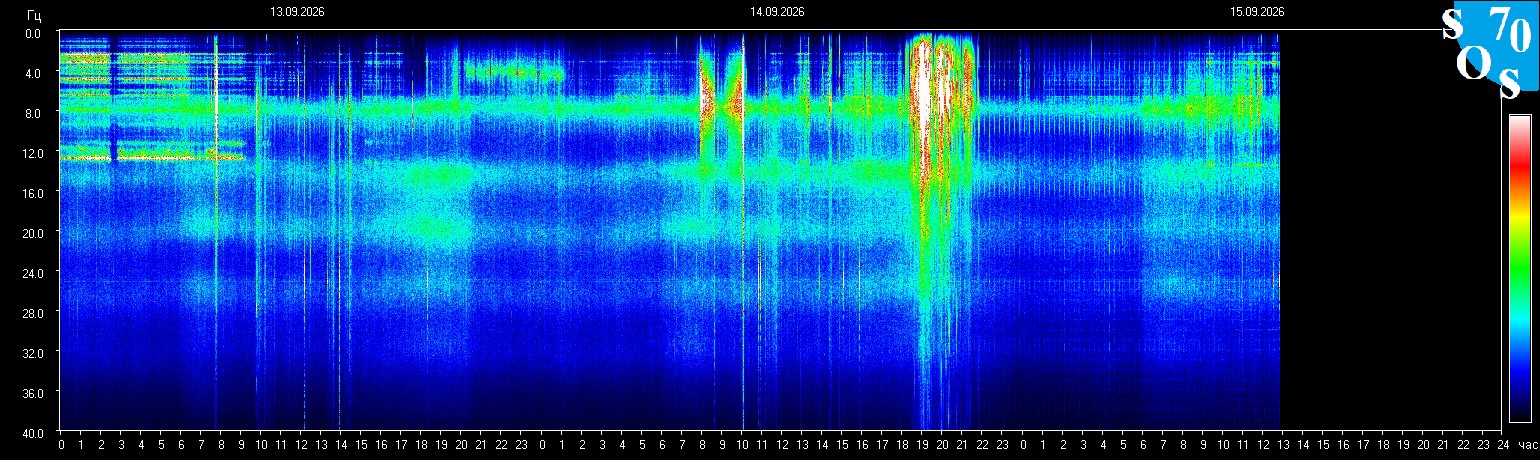
The live chart isn’t reachable right now. The Tomsk feed has outages sometimes — the station’s server has had rough stretches, and when it’s down there is no honest chart to show, so we show none rather than an old one. The rest of this site works fine without it.
You can try the source directly: View the chart at the source (sos70.ru). This page also retries on its own every 10 minutes while it stays open.
Live spectrogram — Space Observing System, Tomsk State University, Russia (sos70.ru). The last 3 days, 0–40 Hz. Chart times are Tomsk local time (UTC+7). View the chart at the source
A note on freshness: if the chart ever looks frozen, check the dates printed along its top — that’s the data’s real timestamp. This site never shows a fake or stale chart as if it were live.
How to read the chart
- Bright horizontal bands at the mode frequencies are the resonance itself. Brightness means energy (amplitude) — the frequencies themselves don’t move; they glow stronger or weaker.
- Black vertical bars mean no data was recorded for that stretch — a gap in the recording, not an event on Earth.
- Bright vertical streaks are usually nearby lightning or local interference at the station in Tomsk — a flash across all frequencies at once, not a change in the resonance.
- The daily texture comes from the world’s three great lightning centers — Africa, Asia, and the Americas — taking turns as the planet rotates and each region’s stormy afternoon rolls around.
Earth’s hum & your brainwaves
Supported The fundamental, ≈ 7.83 Hz, sits right at the boundary of the theta (about 4–8 Hz) and alpha (about 8–13 Hz) brainwave ranges. That overlap is a measured fact about the numbers — two real rhythms that happen to live in the same neighborhood.
Spiritual tradition Still being studied
Many people in spiritual and wellness communities watch this chart daily, and you’ll see claims that Schumann “spikes” change mood, energy, or consciousness, or that the resonance rising means something is shifting for humanity. Those ideas are meaningful to the people who hold them, and the honest label for them is tradition and open inquiry: the overlap in frequencies is real, but a proven effect of the Schumann resonance on how you feel has not been established. We make no promises and no health claims here — just the live data, and room to make of it what you will.
Astrology
Phase 2 · Calculator live
Two great chart traditions, one sky. Enter your birth details once and this page builds both: a Western (tropical) chart with a chart wheel, Placidus houses, and aspects — and a Vedic (sidereal) chart with nakshatras and the Vimshottari dasha timeline. The astronomy is calculated right here; the meanings come from tradition, and they’re labeled that way.
Build your charts — Western & Vedic
The Western chart reads the planets against the tropical zodiac, tied to the seasons. The Vedic chart reads the same sky against the sidereal zodiac, tied to the stars, using the Lahiri ayanamsa. Same planets, two lenses — you’ll get both, with a Western / Vedic switch above the results.
🔒 Only the place name you search is sent to OpenStreetMap to find its coordinates. Your birth date and time never leave this device — both charts are calculated here.
How honest this is: Positions are calculated on this device with a compact ephemeris, accurate to a few hundredths of a degree for most bodies. A placement within about 0.1° of a sign or house edge is borderline. The Rising sign depends on birth time — a few minutes can move it, especially near a sign boundary.
The sky right now — Moon phases & transits
Pick any moment — past, present, or future — and this page works out where the Moon and planets stand at that moment, in the same timezone you picked in the birth form above. The positions and phase are astronomy, calculated here; what tradition makes of them is labeled as tradition.
🌙 The Moon at this moment
✦ Transits — the current sky against your chart
Human Design BodyGraph
Phase 2 · Calculator live
A BodyGraph is not the anatomy map above — it’s a spiritual chart system built from your birth data, with nine centers, 64 gates, and 36 channels. Keeping the two maps separate is deliberate: one describes your physical body, the other is a tradition for reflecting on how you move through the world.
Build your BodyGraph
Enter your birth details and this page calculates your full Human Design chart — Type, Strategy, Authority, Profile, Definition, Incarnation Cross, all nine centers, the defined channels, and every Personality and Design activation with its gate and line.
🔒 Your birth details never leave this device. The whole calculation runs right here in your browser — nothing is sent anywhere, saved, or shared.
How honest this is: the chart is calculated in your browser from astronomical positions, using a compact ephemeris accurate to a few minutes of arc — not looked up from any database. Because gates and lines are narrow slices of the sky, a birth that falls within a few minutes of arc of a gate or line boundary can land one gate or line differently between calculation systems. If your chart sits right on an edge, that’s worth knowing rather than hiding.
What will live here
- Your chart at a glance — Type, Strategy, Authority, and Profile, explained in plain language.
- Nine centers — defined and open centers, and what the tradition says each one is about.
- Gates & channels — the 64 gates and 36 channels, explored one at a time rather than dumped in a wall of text.
- Labeled as tradition — Human Design is a spiritual system, presented as one. It will never be used here to diagnose or assess anyone.
Same birth-data inputs as Astrology, entered once. Calculation arrives in Phase 2 alongside the astrology engine; the design above is final so nothing needs rebuilding.
Feedback
Corrections are welcome here. This site labels its claims honestly — science as science, tradition as tradition — and I would rather fix something that isn’t correct than leave it up. If you spot an error, find something broken, have an idea, or just want to say hi, this is the place.
Testing status — what’s verified, what isn’t
We only mark something tested when it has actually been checked. User listening tests and independent technical measurements are different things, and this page keeps them separate.
✅ Verified by the creator — in-person checks
Phase 1 round: 7 of 7 laptop checks passed. V2 round: 9 of 9 laptop checks passed, plus Android foreground checks through the Muse app. V3 round: 3 of 3 Android Chrome background tests passed. Frequency sweep: 10 of 10 presets passed preliminary independent acoustic verification (full table below). Custom frequency round (2026-11-08): entry verified with safe clamping to 2000 Hz, and corrected measurements 3 of 3 within about 1 Hz of target (detail below). Error handling: passed, user-verified. Local copy: the exported file opened from the creator's own computer in Chrome passed like before. Electronic binaural channel verification: passed on November 8, 2026 (full detail in the list below). Tested in person, November 2026:
- Passed528 Hz preset — audible, steady tone.
- PassedVolume slider — adjusts sound, silent at 0%.
- Passed432 Hz preset — noticeably lower than 528 Hz.
- Passed1-minute timer — stopped playback automatically.
- PassedBinaural audio — sound through both headphones.
- PassedLeft/right difference — each ear sounded slightly different when listened to separately.
- PassedStop button — silenced both channels.
- PassedGentle fades & 20% start volume (V2) — smooth fade-in and fade-out, conservative starting level, confirmed in the nine-check V2 laptop round.
- PassedAndroid through the Muse app — foreground playback, volume, fades, timer, and binaural listening through Bluetooth headphones all passed.
- PassedAndroid Chrome — pressing Home (V3) — audio continued playing through headphones while Chrome was in the background.
- PassedAndroid Chrome — locking the phone (V3) — audio continued playing with the screen locked.
- PassedAndroid Chrome — timer expiration (V3) — after the one-minute session expired, playback stopped and remained stopped when returning to the page.
- PassedCustom frequency entry — entering a value above the allowed range safely clamps to the Studio maximum of 2000 Hz, displayed cleanly as “2000 Hz · custom frequency” at 20% volume, with diagnostics reading Audio engine: running · Page: visible · Session: stopped.
- PassedError handling — rapid Play/Stop about ten times and switching presets during use: no stacked tones, no volume jumps, and nothing played when it should not have.
- PassedLocal copy in Chrome — the exported index.html opened from the creator's own computer (D:\Download\mindful-ones-app) in Chrome passed the tests like before; the site runs correctly as a local file.
- PassedElectronic binaural channel verification — passed on November 8, 2026. Method: stereo WAV recorded through Windows WASAPI using the Elgato-routed website audio, analyzed independently by channel. In both the 10–15-second and 12–17-second sections, left measured 523.000 Hz and right measured 533.000 Hz — a 10.000 Hz separation centered on 528.000 Hz. Opposite-tone content was negligible in the analyzed sections. This verifies the captured digital channel frequencies and separation for this setup. Evidence file: mindful-ones-binaural-528-10.wav (stereo, 48 kHz, 16-bit PCM, 21.05 seconds). The creator's earlier by-ear check (left/right tones sound slightly different per ear) stays recorded above as the subjective check, separate from this electronic one.
Pending — none remaining
No items remain pending. Phase 1 testing is complete. The last pending item — electronic binaural channel verification — passed on November 8, 2026 and is now recorded in the Verified list. Results on this page keep their honest framing: checks done by the creator in person are labeled user-performed or user-verified, and acoustic measurements labeled preliminary stay preliminary — completing the list does not turn them into laboratory-grade certifications.
- CompletePending list: empty — every item on the Phase 1 testing list has now been checked and recorded.
📊 Frequency verification — all ten presets
Every preset was measured independently with the phyphox Audio Spectrum analyzer on a phone, and each reading was recorded by hand. The analyzer resolution was approximately 2.93 Hz.
Preliminary Result: 10 of 10 frequency presets passed preliminary independent acoustic verification.
| Selected | Measured | Difference |
|---|---|---|
| 174 Hz | 172.85 Hz | −1.15 Hz |
| 285 Hz | 284.18 Hz | −0.82 Hz |
| 396 Hz | 395.51 Hz | −0.49 Hz |
| 417 Hz | 416.02 Hz | −0.98 Hz |
| 432 Hz | 430.66 Hz | −1.34 Hz |
| 528 Hz | 527.34 Hz | −0.66 Hz |
| 639 Hz | 638.67 Hz | −0.33 Hz |
| 741 Hz | 741.21 Hz | +0.21 Hz |
| 852 Hz | 852.54 Hz | +0.54 Hz |
| 963 Hz | 963.87 Hz | +0.87 Hz |
The largest absolute difference was 1.34 Hz. All measurements were consistent with their targets within approximately half an analyzer frequency bin. These are preliminary acoustic measurements, not laboratory-grade certifications — they show the tones land where they should within the analyzer's resolution, not lab proof of exact oscillator accuracy.
📱 Android background behavior — observed inside Muse
Documented on Android through the Muse app with Bluetooth headphones. This is recorded as a limitation of that environment, not classified as a sound-engine bug — the cause (Muse's embedded preview vs. Android background-audio rules) is not yet determined:
- ObservedPressing Home or switching apps — the tone becomes inaudible.
- ObservedLocking the phone — the tone also becomes inaudible.
- ObservedWhile in the background — the session timer keeps counting down; the session behaves as suspended, not cancelled.
- ObservedReopening Muse before the timer ends — the tone becomes audible again, with the timer reflecting the elapsed time.
🎛️ Custom frequency testing — user-verified
Reported by the creator on 2026-11-08. Custom frequency entry works: entering a value above the allowed range safely clamps to the Studio maximum of 2000 Hz, displayed cleanly as “2000 Hz · custom frequency” at 20% volume, with the diagnostics reading Audio engine: running · Page: visible · Session: stopped.
Preliminary Corrected phyphox Audio Spectrum measurements: 3 of 3 custom frequencies within about 1 Hz of target, consistent with the preset sweep above.
| Selected | Measured (corrected) | Difference |
|---|---|---|
| 250 Hz | 249.02 Hz | −0.98 Hz |
| 500 Hz | 500.98 Hz | +0.98 Hz |
| 777 Hz | 776.37 Hz | −0.63 Hz |
The analyzer was set to 16384 samples, approximately 2.93 Hz resolution — the same settings as the preset sweep. These are preliminary acoustic measurements, not laboratory-grade certification.
Superseded An earlier measurement attempt of the same three values — 250 Hz → 257.81 Hz, 500 Hz → 492.19 Hz, 777 Hz → 773.44 Hz — was superseded, not deleted: the creator discovered the analyzer's sample-size setting was wrong, fixed the setting, re-measured, and crossed the old values out. The corrected readings above are the official ones.
📱 Android Chrome background tests — user-verified
Tested in person on Android in Google Chrome, outside the Muse app, on the V3 build: 3 of 3 passed. These are user-verified results. Together they strongly suggest the earlier background-audio limitation was associated with Muse's embedded viewing environment rather than an inherent limitation of the sound generator, although the exact cause has not been technically proven. No individual diagnostics-panel readings were reported for these tests, so none are recorded here.
- PassedPressing Home — audio continued playing through headphones while Chrome was in the background.
- PassedLocking the phone — audio continued playing with the screen locked.
- PassedTimer expiration — after the one-minute session expired, playback stopped and remained stopped when returning to the page.
🛡️ Error handling — passed, user-verified
Reported by the creator on 2026-11-08:
- PassedRapid Play/Stop — tapped about ten times: no stacked tones, no problems.
- PassedSwitching presets during use — no stacked tones, no volume jumps.
- PassedNothing played when it should not have.
- Setup-differentHeadphone-disconnect sub-test — not directly equivalent on the creator's setup, because her headphones run through an external audio card. Recorded as setup-different — not counted as passed or failed.
💻 Local copy check — user-verified
The creator opened the exported index.html from her own computer (D:\Download\mindful-ones-app) in Chrome and reported everything passed the tests like before — the site runs correctly as a local file, with no internet or Muse connection needed.
- PassedLocal file playback — the full site works opened directly from the computer's own drive in Chrome.
Implementation notes that can affect those tests
- How tones are made: the Web Audio API generates the exact Hz value shown (e.g. an oscillator set to 528). A spectrum app held near a speaker measures your device's output, room, and microphone as well as the tone — small readings off the exact number usually come from the measuring setup, not the setting.
- Binaural channels: on modern browsers each ear is routed with a StereoPanner (−1 left, +1 right). Very old browsers fall back to a channel merger. A channel-accurate test should record left and right separately, not just listen.
- Timer: two mechanisms run together — a page countdown that calls Stop, and a stop scheduled directly on the audio clock. The audio-clock stop is there because browsers throttle page timers in background tabs.
- Background & lock screen: browsers may pause, throttle, or suspend web audio when a tab is backgrounded or a phone locks, and the behavior differs between browsers and apps. Observed inside Muse on Android: audio goes silent in the background while the timer keeps counting — suspension, not cancellation. In Android Chrome, outside Muse, all three background tests passed (Home, lock screen, and timer expiration stopping and staying stopped). That strongly suggests the earlier limitation was associated with Muse's embedded viewing environment rather than an inherent limitation of the sound generator, although the exact cause has not been technically proven. This page still does not promise uninterrupted background playback on every browser or device. The diagnostics readout in the Studio shows the audio engine's live state while you test.
- Rapid actions: every Play, preset change, or mode switch first disconnects the previous oscillators, then starts fresh ones with a fade-in. If you hear any doubling or click during rapid switching, note the exact steps — that is exactly what the error-handling check is for.
- Try it yourself: play 528 Hz with an analyzer app nearby; in Binaural mode cover one ear then the other; set the 1-minute timer and let it expire; slide volume to 0% while playing. Repeat on your phone as well as your computer.